
Ganesha the Scribe
Many thousands of years ago, there was a Rishi (learned sage), named Krishna Dwaipayana. He gathered all the knowledge of the vedas and organised it in ways people could easily learn and understand. Because of this, he came to be known as Veda Vyasa or Vyasa.
Vyasa had three sons, Pandu, Dhritarashtra, and Vidura. Pandu had five sons called the Pandavas. Dhritarashtra had one hundred sons called the Kauravas, and a daughter. Their capital was Hasthinapura.
During his lifetime, Vyasa witnessed the lives of his sons, grandchildren, and the larger happenings in Bharatavarsha. He also watched the great war at Kurukshetra fought between the Pandavas and Kauravas. The kings of Bharatavarsha took sides in this war, and thousands perished.
Years after the end of the war, after his sons had died, Vyasa went to a cave in the Himalayas. He stayed in dhyana (meditation) for three years. During this time, he saw the complete happenings leading up to the war, and the war itself. All details of the Mahabharata were thus revealed to him.
Vyasa wished to pass on the itihasa of Bharatavarsha for the future citizens of the land. And so, he decided to write down the Mahabharata - the tale of great kings of the Bharata. He could teach the complete story to his students, and they would take it to the far reaches of the land.
As he thought, Brahma appeared before Vyasa and said, “What you seek to do is not an easy task. You need a scribe who can write down thousands of verses of the itihasa without any errors.”
Vyasa bowed and agreed. He replied, “I am not sure who would be willing to attempt this task.”
Brahma smiled and replied, “None other than Ganesha himself can complete this task. Go at once and request His help. As it is a noble cause, He is sure to agree."
Vyasa immediately set out for Mount Kailash where Ganesha lived. He sought the blessings of Ganesha and explained his desire, “O Ganesha, I wish to record the Mahabharata. Future generations can thus benefit from learning the itihasa of their land. I need a scribe who can record the verses as I compose them.”
Ganesha smiled, he understood what Vyasa was hoping for. But he waited for the Rishi to complete.
Vyasa continued, “Brahma himself advised me to approach you. And so, I seek your blessings in this task, and humbly request you to be the scribe.”
Ganesha said, “I agree, but I have a condition.”
“What is it, O Ganesha, I will do my best to fulfil it,” Vyasa replied.
Ganesha said with a smile, “I shall certainly write the verses you dictate. But my quill must not stop at any time. You must keep dictating fast enough to keep me writing without a pause. Can you?”
Vyasa was silent for a moment. He had not imagined such a condition. He wondered how he could possibly compose verses at a speed that would satisfy Ganesha.
Then, an idea struck Vyasa and he said, “I shall do as you ask, O Ganesha. But I have a request of my own too.”
“Certainly, tell me what it is,” Ganesha replied.
“You must not write any shloka without understanding it completely. You must consider all the meanings while you write,” Vyasa requested.
Ganesha nodded and said, “That is a reasonable request. You have my word, I will write only with complete understanding. And now, if you are ready, we may leave.”
Vyasa was overjoyed to have received not only the blessings, but also the support of Ganesha. The two immediately went to Vyasa’s ashram and began their task.
Vyasa began to dictate the verses of the Mahabharata. Ganesha wrote quickly without a single pause. The Rishi started to feel breathless after some time, but Ganesha showed no signs of stopping.
Soon, Vyasa decided to compose a particularly tricky verse. It used complex syllables and carried multiple meanings.
Ganesha lifted his quill and paused for a moment to consider the shloka from all angles to uncover all its possible meanings. While Ganesha thought, Vyasa composed several more shlokas in his mind.
When Ganesha set his quill to the palm-leaf again, Vyasa had taken a few breaths and he resumed dictating the verses. This happened several times in each sitting.
The entire Mahabharatha has over 1,00,000 shlokas. Of that, the full meaning of 8,800 shlokas were known only to Vyasa muni and his son Suka deva.
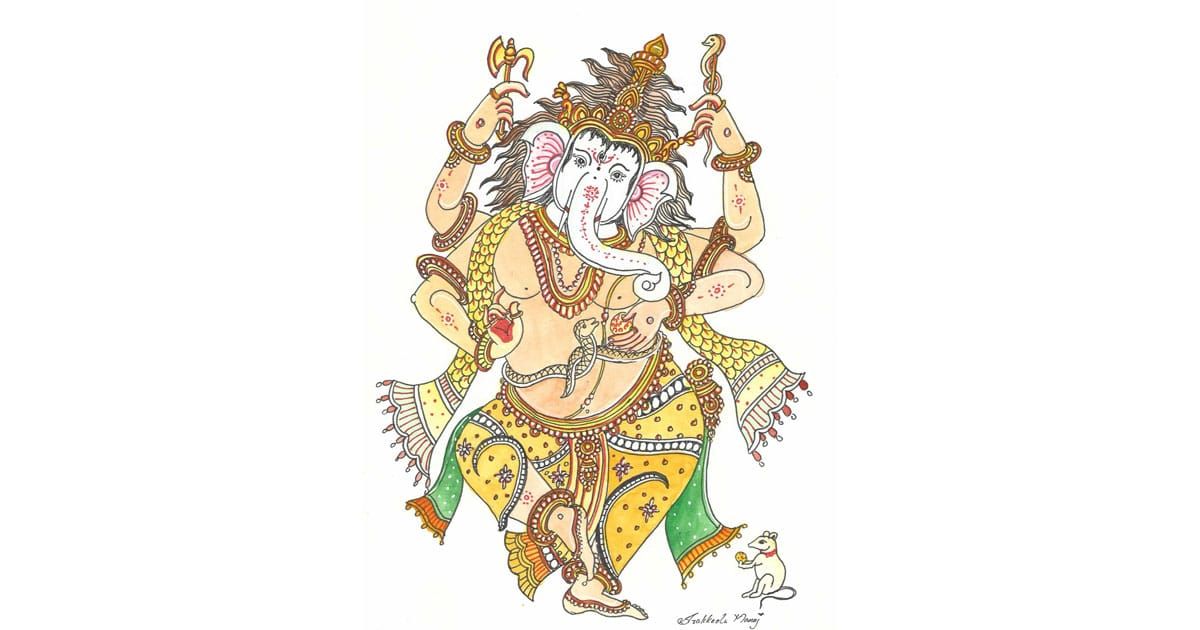
You might have noticed that Ganesha has only one tusk. This is one of the stories about why Ganesha is also known as Eka-danta or the one-tusked-Devta.
It is said that Ganesha wrote so fast that his quill broke while he was writing the Mahabharata. Vyasa could not stop as he had already promised to keep dictating without a pause. And so, Ganesha broke off one of his tusks and continued writing with it.