
Story: The Mango Tree
Eight-year-old Venkat is tired of the lockdown. He is fascinated by the mango tree he sees outside his window. He longs to climb the tree and play in it but the tree is inaccessible. Read on to find out what happens next...
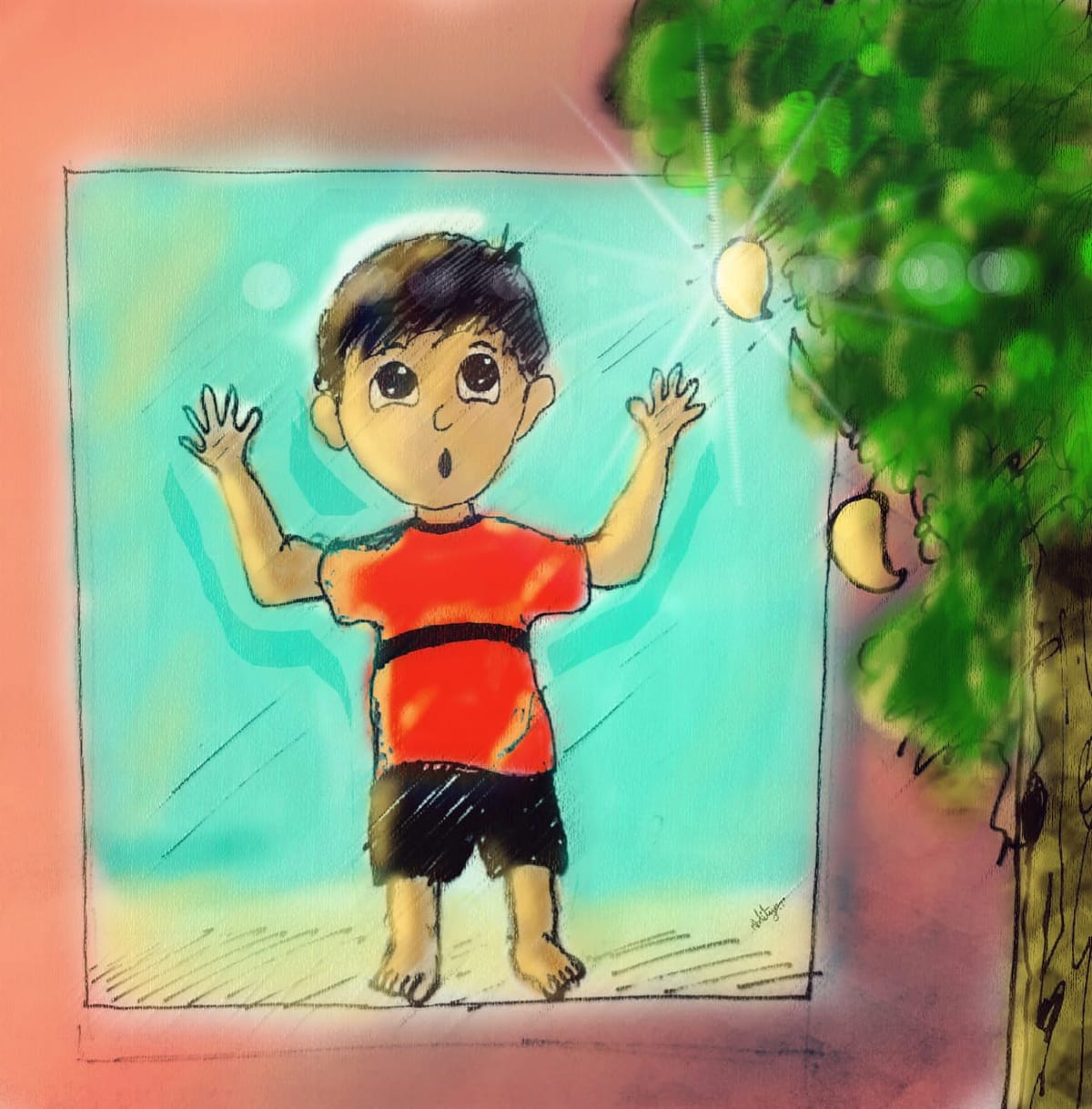
Eight-year-old Venkat was looking out of the window. His nose and palms were pressed against the glass pane, and he was lost in thought. This was quite unusual because no one had ever seen Venkat stay still for more than a few minutes at a time. His grandfather had given him the nickname toofan when he was about three years old, and the name stuck ever since. His mother, who was passing by the room, was quite amused. She took a quick photo of Venkat with her phone and sneaked out.
Venkat’s family lived in a third-floor apartment in Hyderabad. Their apartment was at the quiet end of a dead-end street that led off a busy arterial road. Right across the street from Venkat’s building was an old house. It was one of the rare few left in this central part of the city. All other houses had long been replaced by apartment buildings.
The house stood in the middle of a large, disused compound surrounded by a high wall and a gate topped with spikes. Nothing grew in the garden except for a beautiful mango tree. This tree was the object of Venkat’s dreams. Alas, he could not access it. A large sign on the gate read, “NO TRESPASSING. NO MANGOES”.

To make matters worse in Venkat’s mind, the tree was full of fruit this April. A security guard with an imposing moustache stood by the gate, holding a thick lathi. Although a mask hid the guard’s moustache during the lockdown, Venkat was still terrified of the man.
A familiar voice pierced through Venkat’s daydream. He realised with a start that it was his mother’s voice. It wasn’t her regular voice. It was her angry voice. And it was saying, “Venkat! This is the sixth time I’ve called you! Are you coming for lunch?”
Venkat sighed. “Coming, Amma!” he called back. Not only was he trapped at home during the lockdown, but he also had to face his angry mother now. “It’s just not fair!” Venkat grumbled to himself as he washed his hands.
Venkat’s family was already seated around the dining table and halfway through their meal by the time he finally made it to lunch. His four-and-a-half-year-old sister, Pragya, was sitting next to their father. Her mouth was stuffed. “This is my second serving of potato fry,” she said, spewing particles of food everywhere. Nanna tapped her on the back of her head. “No talking while eating,” he scolded.
“Amma!” Venkat whined, looking at his own plate with its small serving of potato. “It’s not fair that she gets more!”
There was silence at the table as Amma glared at Venkat. Oops! He’d forgotten it was angry Amma. “Sorry, Amma!” he said quickly. But it was too late. His potato fry had vanished. In its place was Venkat’s least favourite food in the world – spinach dal.

“If you want your share, Venkat,” Amma said in a stern voice, “learn to make it to the table on time.”
Amma soon finished her meal. She rose from the table, saying, “I have a call.” Turning to Venkat’s Taatha, she asked in a gentle voice, “Would you like anything else?” Taatha shook his head. “Good food,” he said to Nanna. Then he leaned on his cane and got up too. Amma smiled as she cleared her plate and that of Taatha before leaving to take her call.
“Eat, Venkat,” said Nanna. “Finish your pappu, and you can have the last of the potato.” As Venkat continued to look glum, Nanna added, “Cheer up! I’ll make you some more potato fry soon!”
Venkat was the very picture of misery as he ate. His father laughed and gave him a papad. He also added a dollop of fresh mango pickle for good measure. “Why don’t you live in this world with the rest of us?” he asked. “Your troubles would vanish if you stopped disappearing into your daydreams all the time.”
“Yes, Anna! Stay in our world and play with me!” Pragya bounced, spewing yet more food particles within a five-foot radius. This earned her another gentle tap on the head. Venkat glared at her. Pragya was the cause of half his troubles, he thought unfairly. The other half, he reflected fairly, was all him.
“Eat, Venkat, I’ll tell you a story after my nap,” called Taatha from halfway to his room.
“I don’t want a story. I want mangoes!” Venkat said, petulantly.
“Ah! Well, perhaps I can tell you a story about a mango tree,” Taatha said, with a twinkle in his eye. Then he vanished into his room for a siesta.
As Nanna worked in the children’s room during the day, Venkat and Pragya were allowed to watch an hour of TV while Taatha napped. After he woke up, Taatha would spend some time with them till one of their parents finished their work.
Venkat always felt restless in the afternoons. The lockdown seemed endless, and there was nothing to do. It’s not as though he intended to cause trouble as much as trouble seemed intent on finding him. His sister, on the other hand, always seemed to be in the good books of the grown-ups.
Every afternoon, Pragya insisted on watching a cartoon featuring a family of talking pigs. Venkat put on her show and picked up a book. He curled up in his favourite corner of their large L-shaped sofa.
Venkat soon felt thirsty. He opened the fridge and grinned. Amma had made a jug of his favourite lemonade with little pieces of fruit in it. She had stuck a yellow note on the jug. It said, “For my little hero who gets hungry and thirsty all at once. Others DO NOT touch.”

Venkat poured himself a glass of lemonade. He stuck a spoon in it to fish out the fruit and cracked open his book. It was an adventure featuring children from a gurukul who fought off Asuras from another world. As he read, his mind wandered back to the mango tree.
The tree presented unlimited possibilities to Venkat’s mind. He could climb the tree, eat the raw mangoes, break off a few sticks to fight with his friends, tie an old tyre to a sturdy branch and swing on it. Even his little sister would have great fun playing with the twigs and leaves he shook down for her (she couldn’t climb trees yet). If it wasn’t for the lockdown, he and his friends could have hidden in the tree and jumped on the rival gang from Gulmohar Towers next door. What fun that would have been!
Venkat sighed and tightly closed his eyes. “Just the one tree,” he prayed with full faith. “If you just give me access to just that one mango tree for just this one summer, Hanumanji, I won’t complain about the lockdown anymore at all.” Venkat opened one eye as though expecting to find himself in the tree.
Instead, he was in his living room. And his sister was giggling as the family of pigs wallowed in a muddy puddle. Hanumanji continued to silently transport the Sanjeevani mountain on the calendar. There was no sign of the mango tree.
“That’s it,” Venkat said, switching off the cartoon. “Enough pigs for one day. Let’s play Uno instead.” “Yay!” said his sister.

Venkat was a wonderful brother. He let his sister win at Uno and Snakes and Ladders for an hour while he dreamt about his tree. At around three o’clock, Taatha and Amma emerged from their rooms. Amma went into the kitchen to prepare coffee for the grown-ups and milk for the kids. Taatha joined the children for a game of Uno and squarely beat Pragya. “Don’t let her win all the time. It’s not good for her,” he told Venkat. “I don’t let her win all the time,” said Venkat wisely as Pragya went to put the games away. “Only when grown-ups aren’t around,” he whispered.
Taatha laughed and ruffled Venkat’s hair affectionately as he accepted his cup of coffee from Amma. “Venkat,” he said, “I saw you looking at the mango tree across the street. Why are you so fascinated by it?”
“I’m so tired of the lockdown, Taatha,” Venkat said. “I know it’s for our own safety, but I miss my friends. I really miss playing outside. Each time I look at the tree, it just seems to be calling my name and asking me to climb it.”
“What if I told you I know the owner of the tree?” Taatha asked.
“What? Do you know the owner of the house? Why didn’t you ever tell us?” Venkat asked excitedly.

“I don’t like to talk about it,” Taatha said with a sigh. “The house belongs to a friend of mine. His name is Subbiah. Well, Subrahmanya Murthy, really. He and I grew up together in a village about two hundred kilometres from here.
“It was the time of great revolutionary heroes like Komaram Bheem, Yella Reddy and Anabheri Prabhakar Rao. Thousands of young people joined their movements. Subbiah and I have been friends since those times. Although we were too young to participate, we did what we could to help the cause. When we finished our studies, many of us moved to Hyderabad seeking employment in the newly formed government of Andhra Pradesh.
“Subbiah and I got married within a few months of each other. We decided to buy land here and build our houses. He planted a mango tree in his garden. I planted a jackfruit tree here in ours. He promised me that he would let his tree stand until my grandchildren were old enough to climb it. I promised him that he would have jackfruit to eat as long as he lived. It is his favourite fruit.
“About five years ago, when your grandmother passed away, I could no longer bear to live in the big house all by myself. You still lived in America then. Your parents were doing so well in their careers there that I never imagined they would want to come back. So I gave the house over to the developer who built this block of flats. Subbiah was heartbroken with my decision.
“I always thought he would come around. But he has never forgiven me for allowing the tree to be cut down. I suppose it was too much change for him to handle. All three of his children are in America, and he’s all alone, as I was. If I had known you would move back, I would never have given away the house.”
Taatha’s eyes glistened with tears. Amma gently patted his hand and said, “You did the right thing for our family and for the city. Cities need to grow, too, and make room for new people. I only regret that the builder of this complex did not design the building around such a magnificent old tree.”
“Spoken like a true architect,” Taatha said, beaming with pride.
“Venkat,” Taatha said. “Why don’t you take this letter over to Subbiah’s house and give it to the security guard? Let us see if my old friend will keep his promise even though I have broken mine.”
“Don’t forget your mask!” Amma called out.
Venkat wore his mask and ran to Subbiah’s house. The guard turned out to be quite a friendly man. He promised to deliver the letter to his employer.
A few hours later, Venkat and his family had just sat down for dinner when the doorbell rang. Nanna came back holding a letter. “It’s from your friend,” he said to Taatha.
“Read it aloud for me,” said Taatha.
“Dear old friend,” Nanna read. “I have long forgotten the tree, but I miss my friend every day. While I am too old to eat jackfruit now, your grandchildren are just the right age to play in the mango tree. You and your family must promise to come and spend the rest of the summer here with me. I meant to move to America permanently to live with my children, but the lockdown changed our plans. Next year, this house will be gone. I am so glad you wrote to me before it was too late.”

Venkat’s family was touched by the letter. They accepted the invitation and moved into Subbiah’s house for the rest of the summer. Amma and Nanna still came back home to cook meals and take calls. But Venkat spent most of his time in the mango tree, doing everything he’d dreamt about, except spooking his rivals.
At the end of the summer, when the mangoes were long gone and travel had resumed, Subbiah’s son came to take his father to live with him in America. Venkat’s parents had a long conversation with them. Finally, Amma announced, “We spoke to Subbiah Taatha’s builder. My company will take over the design of the new building.”
And so, when the new apartment building came up, it was designed to protect the mango tree. Venkat never did get to climb the tree again. But then, he’d only prayed to Hanuman to let him play in it for one summer.